
 English
 Polski
 Deutsch
 Nederlands


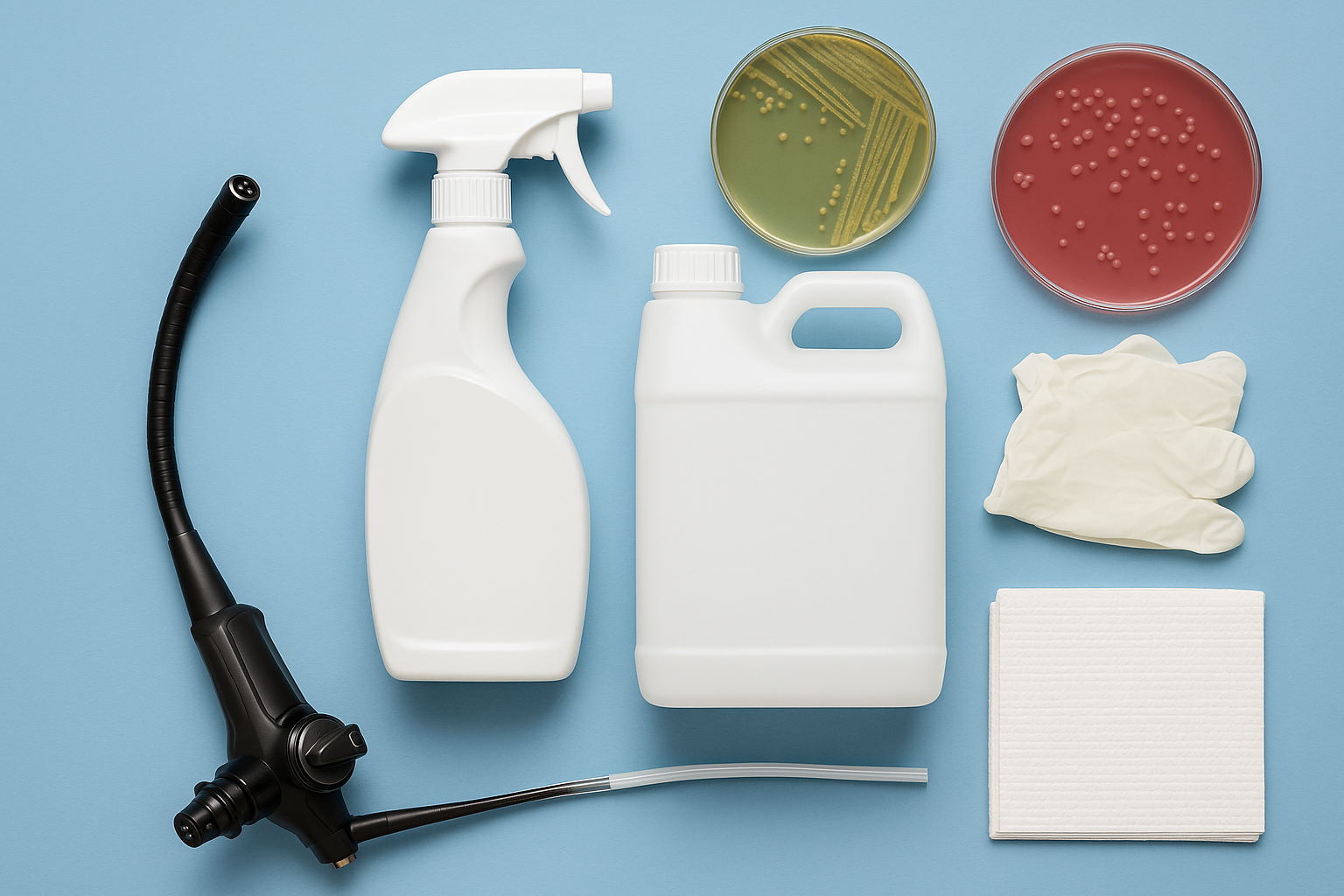
The Best Sporicidal Disinfectants – How to Choose an Effective Solution Against Bacterial Spores
Test Microorganisms for Evaluating Sporicidal Effectiveness
European hygiene standards emphasize the role of test microorganisms – selected, highly resistant strains that serve as a benchmark for evaluating the efficacy of disinfectants. While they may not always be clinically relevant, proving effectiveness against these organisms confirms a product's broad antimicrobial action.
What Are Bacillus Spores and Why Are They Important?
The most common test organisms in sporicidal testing are Bacillus subtilis and Bacillus cereus:
B. subtilis – forms extremely durable spores. Some have survived over 24 years in harsh environments, including the Mariana Trench. Scientists believe they could survive for up to 500 years.
B. cereus – its spores resemble B. anthracis (anthrax) morphologically, though they lack a capsule. This makes it a valuable model organism in testing.
These spores are also used as biological indicators in sterilization processes where the goal is absolute microbial elimination.
Comparing the Effectiveness of Disinfectants on Different Spores
Key differences include:
B. subtilis spores are more resistant to glutaraldehyde than B. cereus.
The reverse is true for peracetic acid.
Clostridioides difficile spores are more susceptible to glutaraldehyde than B. subtilis, but less than B. cereus.
Thus, general sporicidal efficacy cannot be equated with effectiveness against C. difficile – hence the importance of clearly defined testing standards.
Standard PN-EN 17126 – Essential in Healthcare
According to PN-EN 17126, a disinfectant is:
Classified as sporicidal if it is effective against B. subtilis and B. cereus spores.
If it works only against C. difficile R027 spores, it must be labeled as "effective against C. difficile spores."
This distinction is critical for high-level disinfection, particularly in cases where thermal sterilization isn't possible – such as with flexible endoscopes.
Practical Examples – Which Products to Choose?
Phago’scope APA (Christeyns)
Peracetic acid-based solution with 5-minute activity. Proven efficacy against B. subtilis, B. cereus, and C. difficile R027 under EN 17126.
No activation needed. Remains effective for up to 15 days after preparation and allows for multiple uses.
Oxivir Sporicide (Diversey)
Ready-to-use foam with broad-spectrum action (bacteria, yeasts, fungi, mycobacteria, Polio/Adeno/Noro viruses), plus sporicidal action under EN 17126.
Works in just 1 minute – ideal for fast cleaning of medical surfaces, even in patient areas like ICUs and neonatal units.
Recommendations and Best Practices
Always verify that the product has been tested under the appropriate standard: PN‑EN 17126 for medical use, or EN 13704 / EN 14347 in soiled environments (if EN 17126 isn’t applicable).
Routinely monitor the active solution’s efficacy – especially when using multi-use sporicidal agents like Phago’scope APA.
Keep in mind: lab conditions rarely reflect real-world settings (e.g., organic matter, biofilms) – adjust accordingly.
Summary & Final Thoughts
In both medical and cosmetic environments, patient safety must come first. Choosing the right disinfectant should be based on:
Confirmed compliance with standards (PN‑EN 17126, EN 13704)
Verified effectiveness against relevant spores (Bacillus + C. difficile)
Reliable results in the presence of organic contamination
This approach ensures not only surface-level cleanliness but true protection against the most resilient pathogens.
Quick Comparison Table:
| Product | Active Ingredient | Contact Time | Tested Under |
|---|---|---|---|
| Phago’scope APA | Peracetic acid | 5 min | EN 17126 (Bacillus + C. difficile R027) |
| Oxivir Sporicide | Hydrogen peroxide | 1 min | EN 17126; virucidal (Polio/Adeno/Noro) |
| others (e.g. powders) | Glutaraldehyde, OPA | 15–60 min | EN 13704 / EN 14347 |
Oxivir works great for time-sensitive tasks, while Phago’scope APA fits well in semi-automated disinfection workflows – especially for endoscopes.


